J. I. Hutchinson, Theory of Functions (Cornell, 1904), pp. 3–10
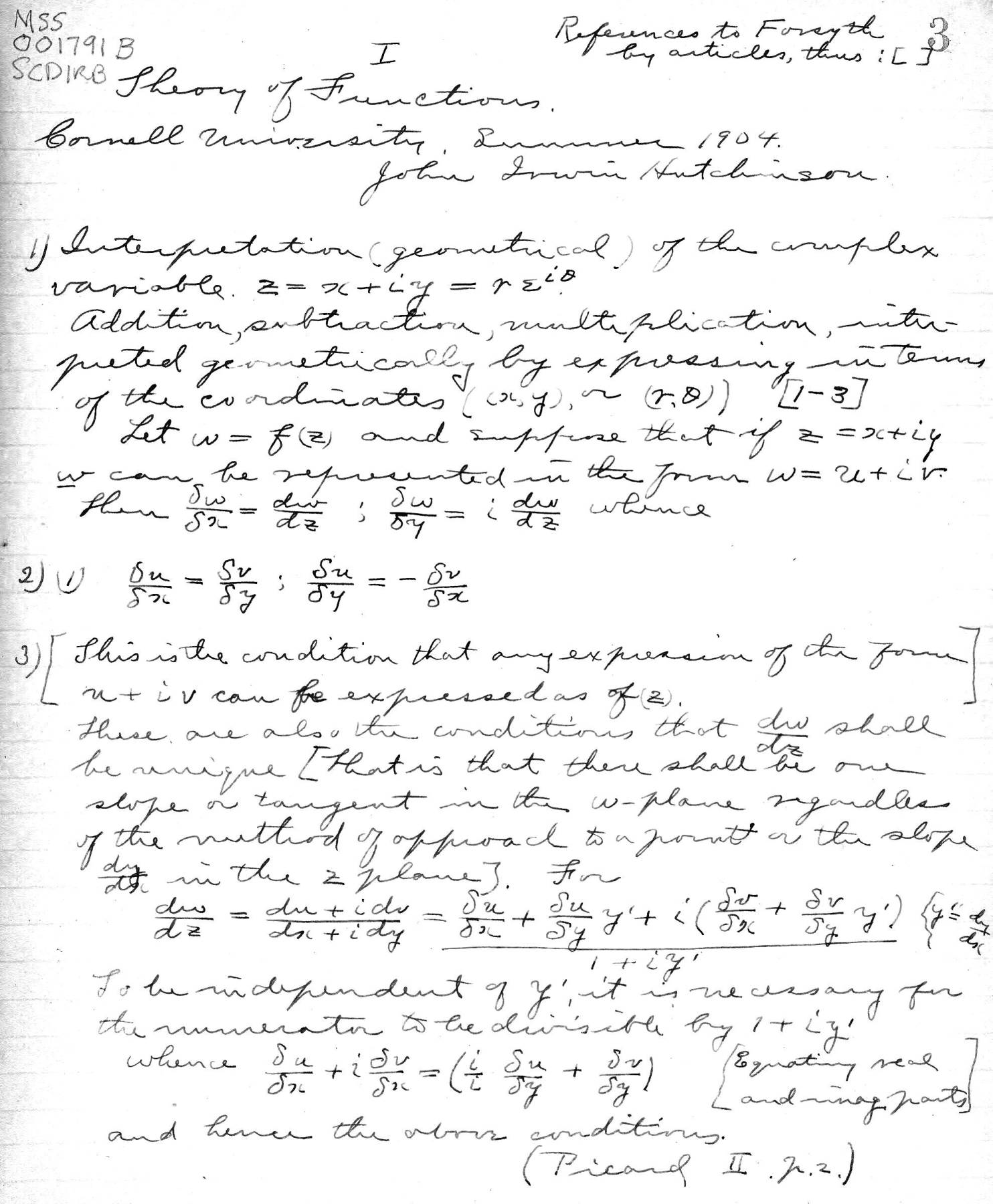
MSS
B
SCDIRB Theory of Functions.
I
References to Forsyth
by articles, thus : [ ]³
Cornell University, Summer 1904.
John Irwin Hutchinson
1) Interpretation (geometrical) of the complex
variable.
Addition, subtraction, multiplication, intro-
preted geometrically by expressing in terms
of the coordinates (x,y), or (r,θ)) [1-3]
Let w f(z) and suppose that if z
w can be represented in the form w
then whence
3) [ This is the condition that any expression of the form]
u+iv can be expressed as of(z).
These are also the conditions that dw shall
these are also the conditions that \dz shall
be unique [that is that there shall be one
slope or tangent in the w-plane regardless
of the method of approach to a point on the slope
in the z plane]. For
To be independent of y, it is necessary for
the numerator to be divisible by
whence [Equating real
[and imag^y parts]
[and imag parts]
and hence the above conditions.
(Picard II.n.2.)
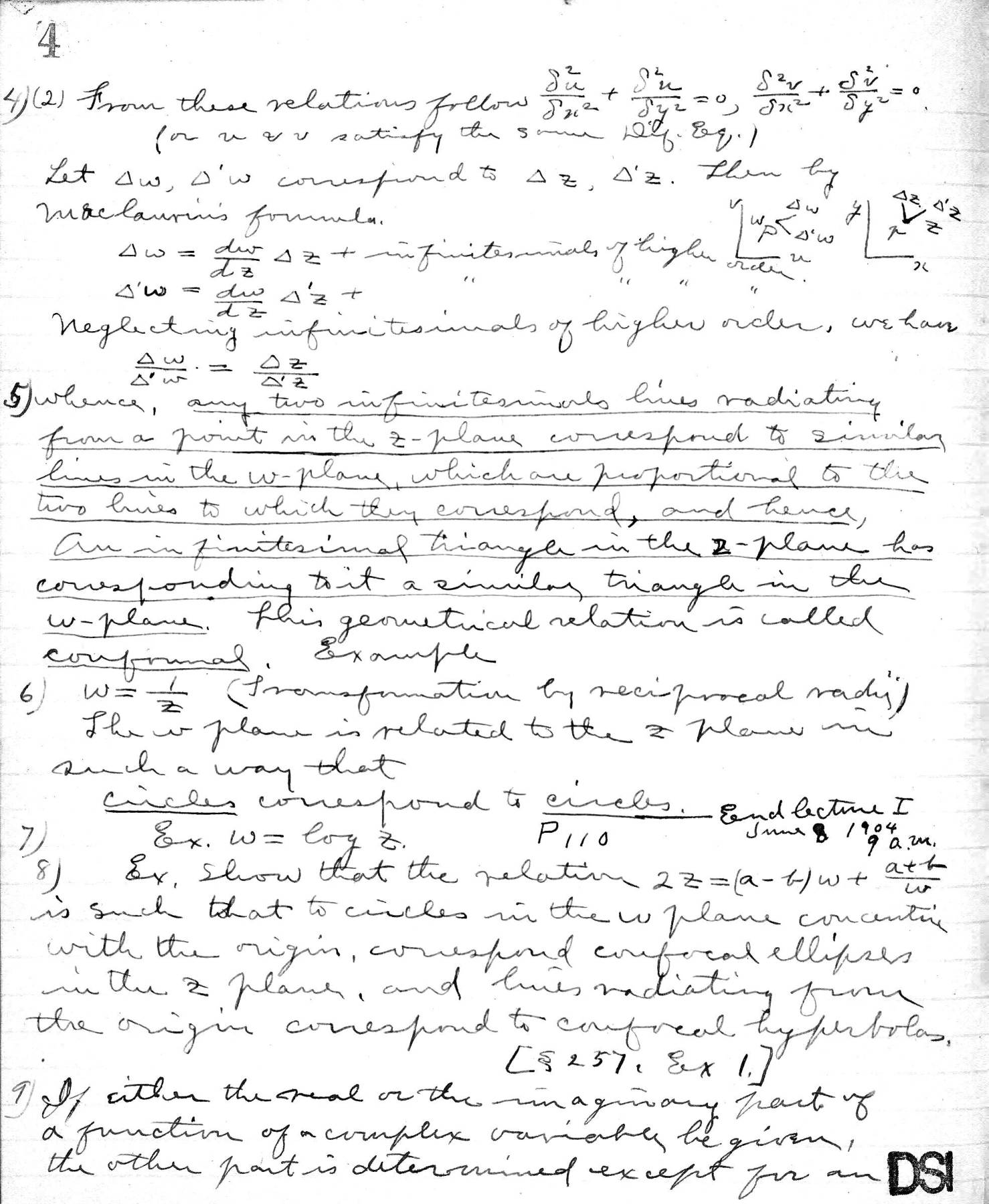
4)(2) From these relations follow
these relations follow (or u & v satisfy the same Diff. Eq.)
w correspond to z. Then by
Maclaurin's formula.
\Delta w = \dfrac{dw}{dz} \Delta z + \text{infinitesimals of higher order.}
\Delta' w = \dfrac{dw}{dz} \Delta' z + " " " " "
Neglecting infinitesimals of higher order, we have
5) whence, any two infinitesimals lines radiating from a point in the z-plane correspond to similar
lines in the w-plane, which are proportional to the
two lines to which they correspond, and hence,
An infinitesimal triangle in the z-plane has
corresponding to it a similar triangle in the
w-plane. This geometrical relation is called
conformal. Example
6) w (transformation by reciprocal radii)
The w plane is related to the z plane in
such a way that
circles correspond to circles. ___ End lecture I
P110 June
8) Ex. Show that the relation
is such that to circles in the w plane concentri
with the origin, correspond confocal ellipses
in the z plane, and lines radiating from
the origin correspond to confocal hyperbolas.
[§ 257, Ex 1.]
9) If either the real or the imaginary part of
a function of a complex variable be given, the other part is determined except for an
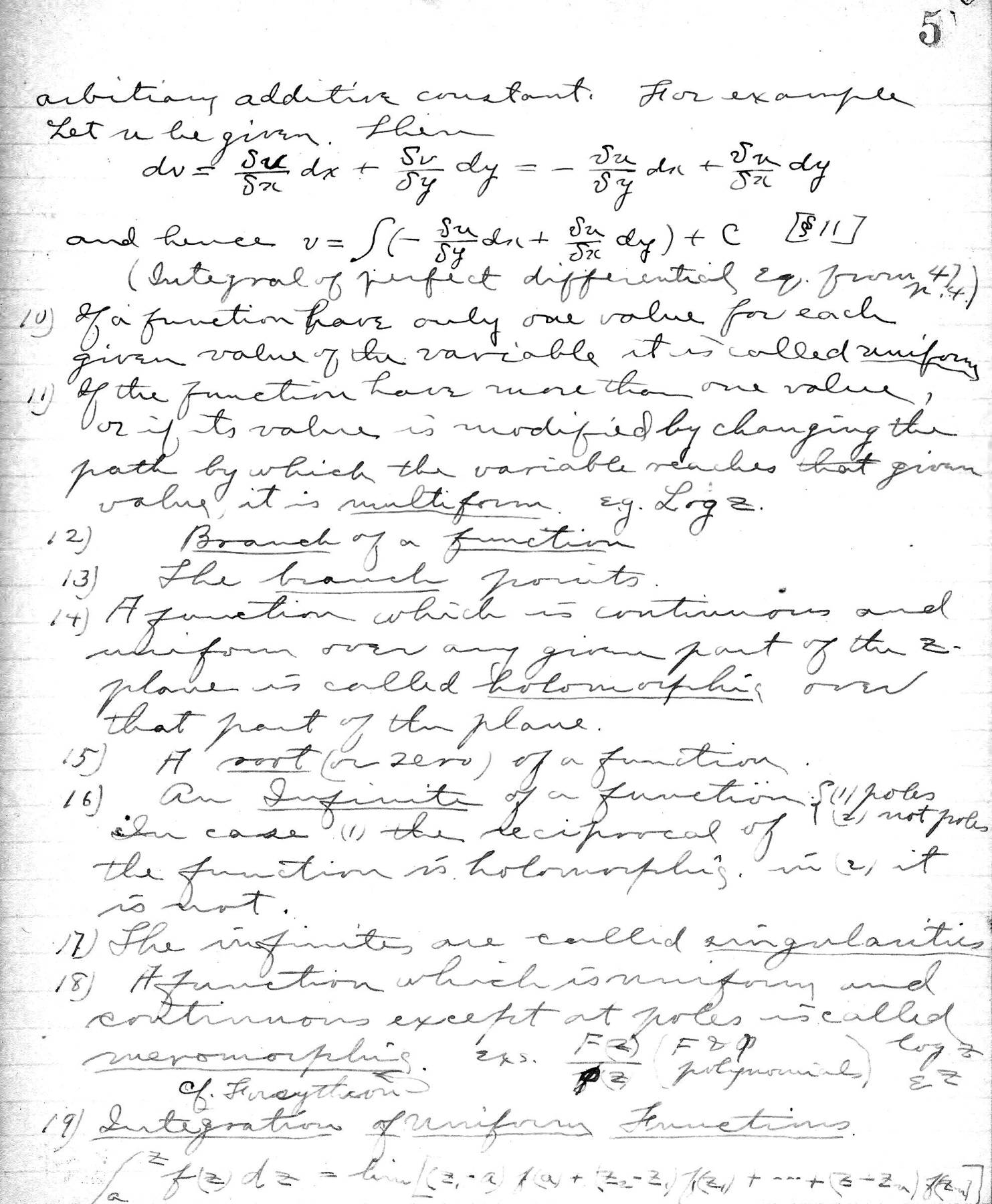
arbitiary additive constant. For example
Let u be given. Then
dv
and hence v
(Integral of perfect differential eq. from
(10) If a function have only one value for each
given value of the variable it is called uniform
1) If the function have more than one value,
or if its value is modified by changing the
path by which the variable reaches that given
path by which the variable reaches that give-
value, it is multiform. E.g. Log z.
(2) Branch of a function
(3) The branch points.
(4) A function which is continuous and
uniform over any given part of the z-
plane is called holomorphic over
that part of the plane.
(5) A root (or zero) of a function.
(6) An Infinite of a function. {(1) poles
in case (1) the reciprocal of {(2) not poles
the function is holomorphic. in (2) it
is not.
17) The infinities are called singularities
18) A function which is uniform and
8) A function which is uniform and continuous except at poles is called
endomorphing. Exs. P3 (polynomial) E/Z
cf. Forsythe on
19) Integration of uniform functions.
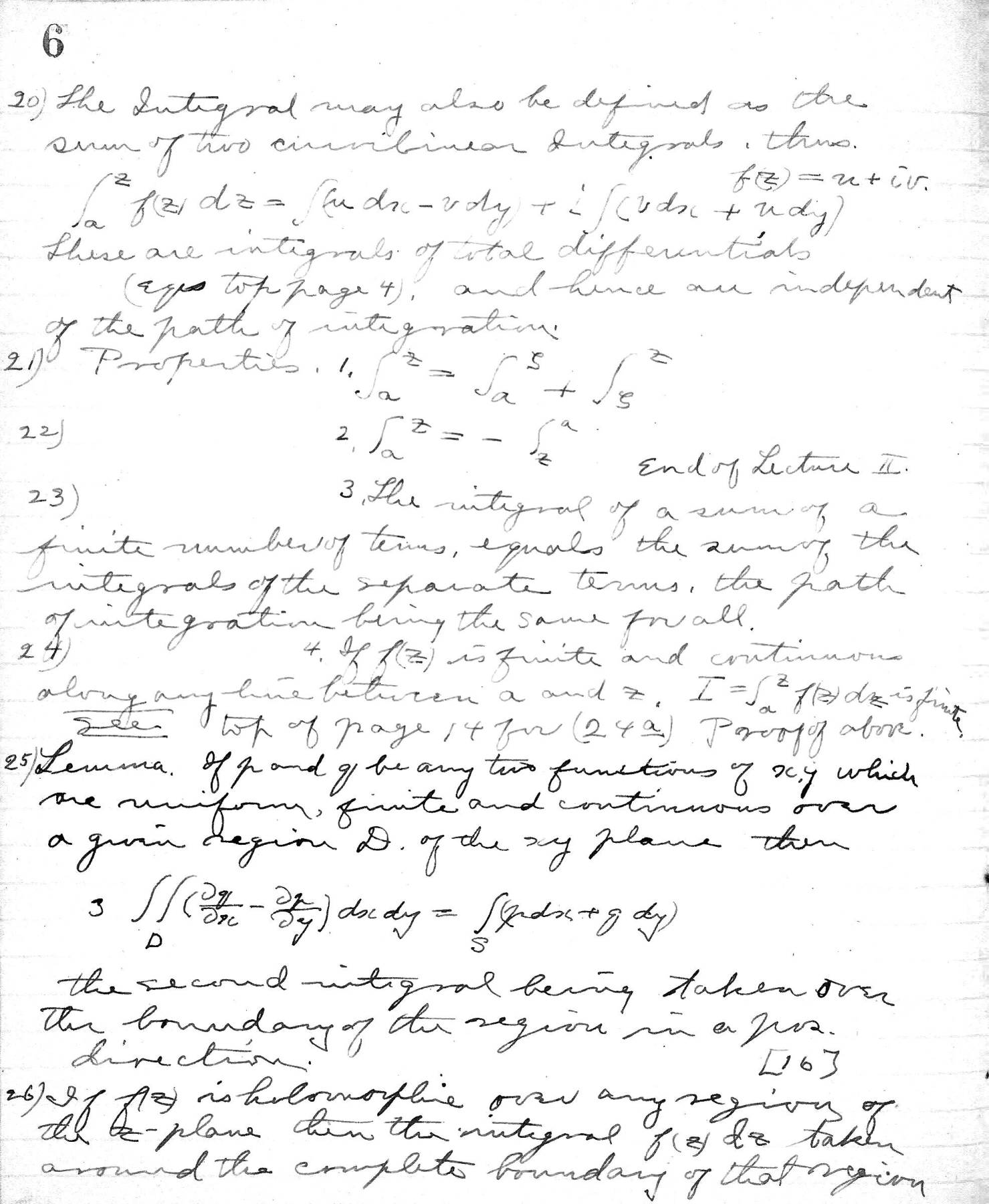
20) The Integral may also be defined as the
sum of two curvilinear integrals, thus.
f(z)
These are integrals of total differentials
(eqns top page 4), and hence are independent
of the path of integration.
2) Properties. 1,
23)
3. The integral of a sum of a
finite number of terms, equals the sum of the
integrals of the separate terms, the path
of integration being the same for all.
4. If f(z) is finite and continuous
along any line between a and z. I f(z) dz is finite
See top of page for (24a) Proof above.
25) Lemma. If p and q be any two functions of x,y which are uniform, finite and continuous over
a given region D. of the xy plane then
dy)
the second integral being taken over
the boundary of the region in a pos.
direction.
[163]
26) If f(z) is holomorphic over any region of the z-plane then the integral f(z) dz taken around the complete boundary of that region
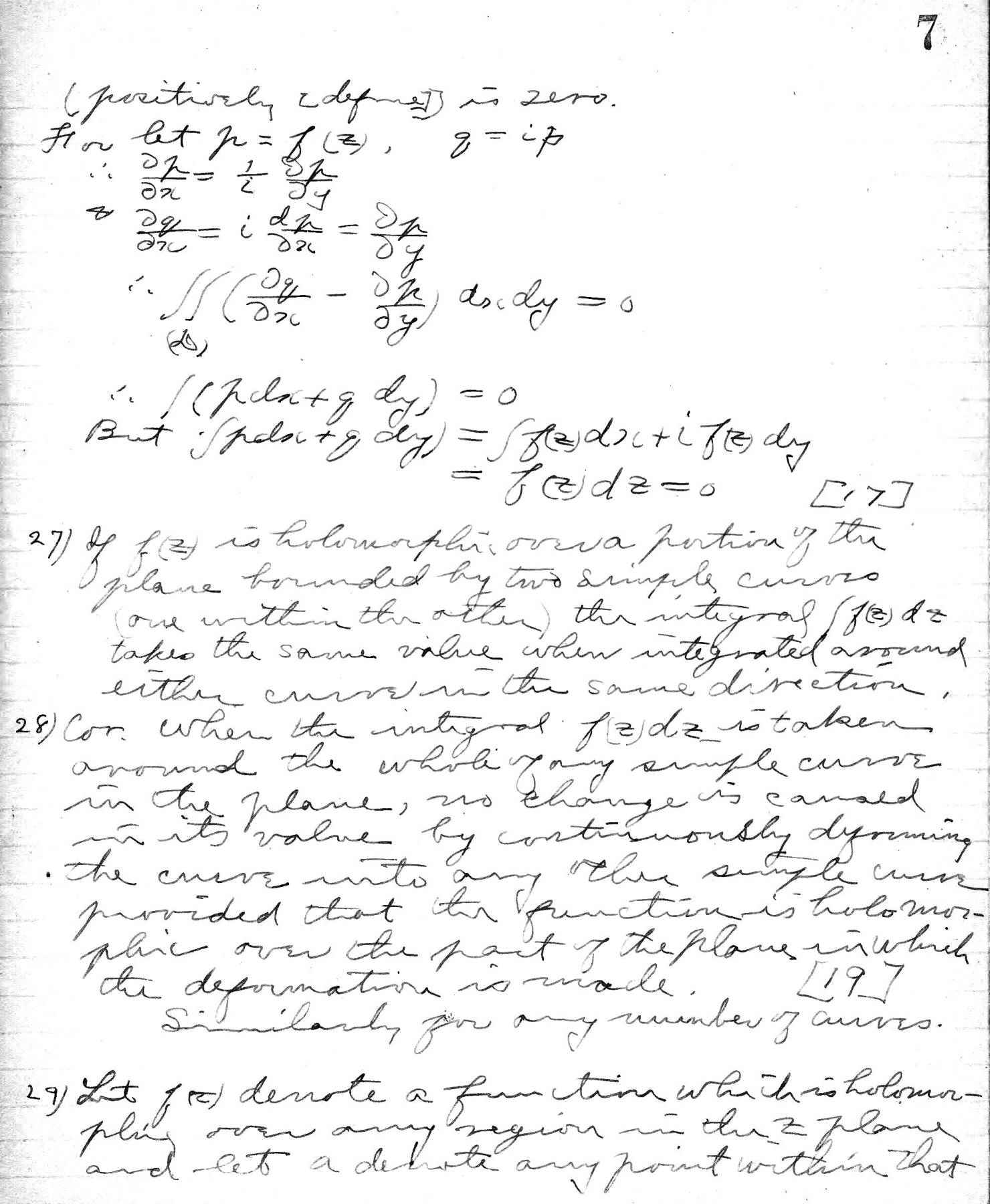
(positively definite) is zero.
If we let ,
∴
[17]
27) If f(z) is holomorphic over a portion of the
plane bounded by two simple curves
(one within the other) the integral
takes the same value when integrated around
either curves in the same direction,
28) Cor. when the integral f(z)dz is taken
around the whole of any simple curve
in the plane, no change is caused
in its value by continuously deforming
the curve into any other simple curve
provided that the function is holomor-
plic over the part of the plane in which
the deformation is made. [19.]
Similarly for any number of curves.
29) Let f(z) denote a function which is holomor-
phic over any region in the z plane
plily over any region in the z plane
and let a denote any point within that
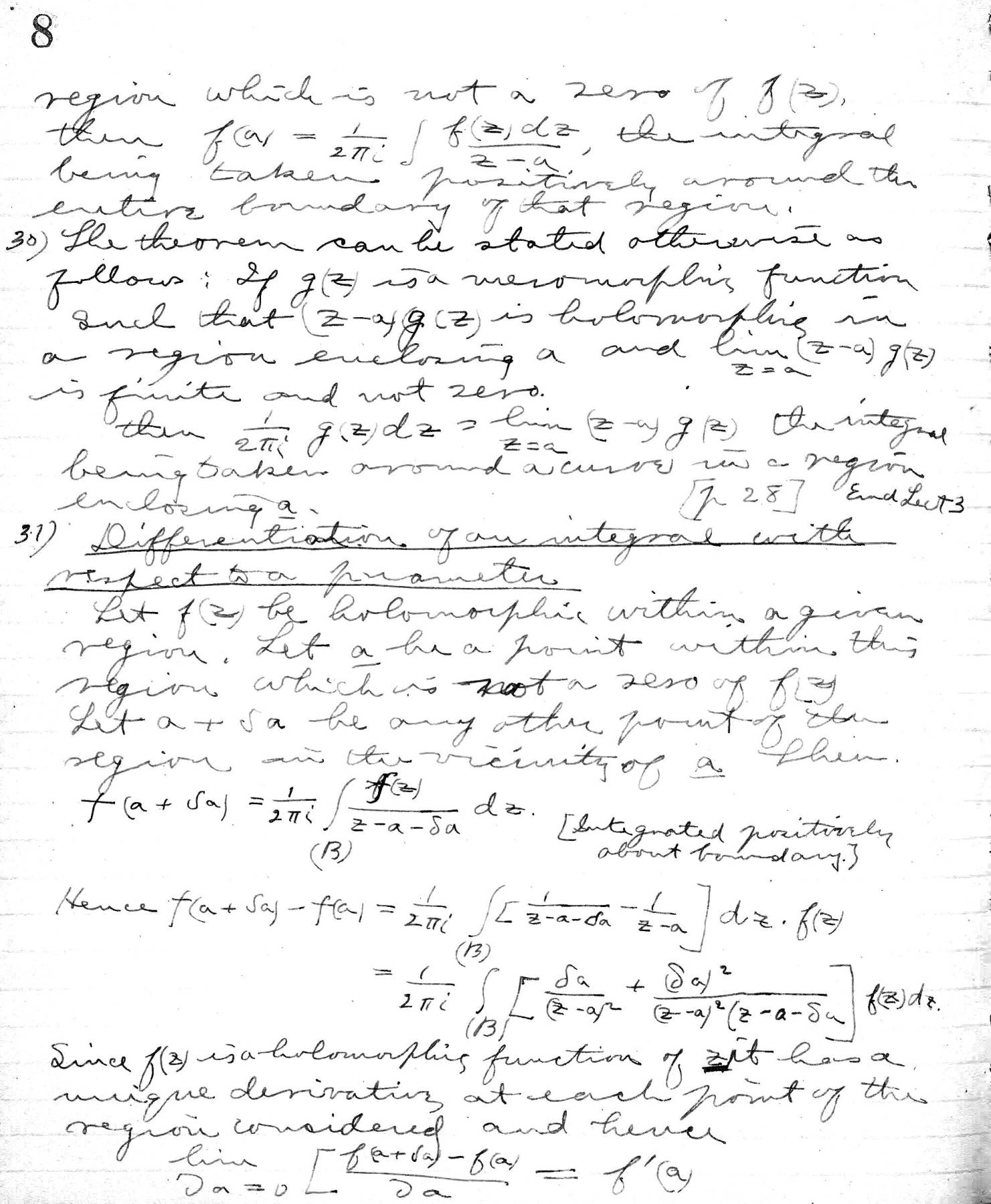
region which is not a zero of f(z),
then f(a) the integral being taken positively around the
entire boundary of that region.
30) The theorem can be stated otherwise as follows: If g(z) is a meromorphic function
such that (z-a)g(z) is holomorphic in
a region enclosing a and is finite and not zero.
finite and not zero.
then (z-a) g(z) the integral
being taken around a curve in a region
enclosing a. [p 28] End Lect 3.1) Differentiation of an integral with
respect to a parameter
Let f(z) be holomorphic within a given
region. Let a be a point within this region which is not a zero of f(z)
a be any other point of Eta
region in the vicinity of a. Then.
f(a dz.
(B)
[Integrated positively about boundary.]
Hence f(a+ δa)
Since f(z) is a holomorphic function of z it has a
unique derivative at eash point or th-
unique derivative at each point of this
region considered and hence
lim [f(a+δa) - f(a)
δa=0 [ ___________ = f'(a)
δa
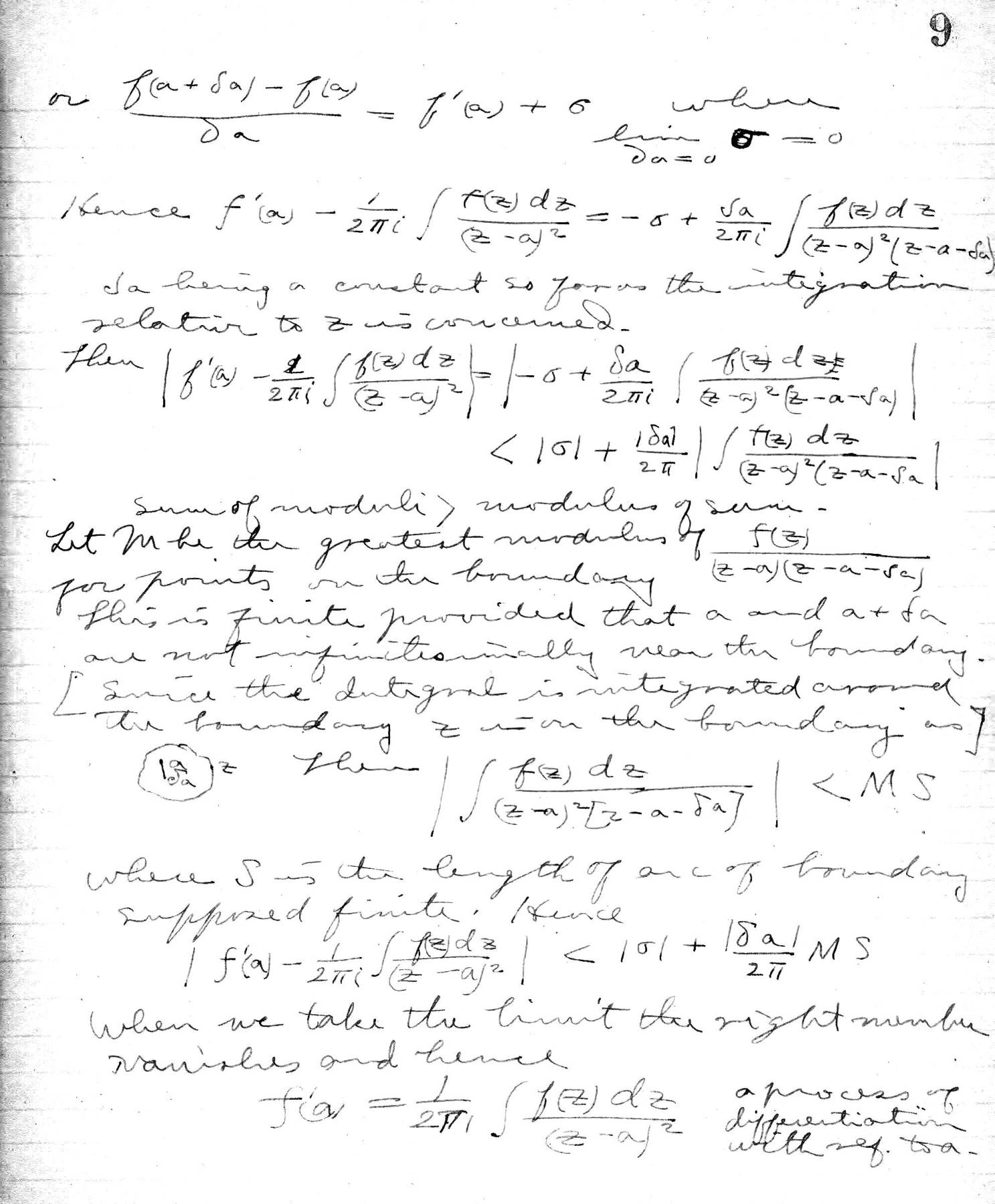
where
Hence f'(a)
δa being a constant so far as the integration
relative to Z as concerned.
Then |f'(a)
sum of moduli modulus of sum.
Let M be the greatest modulus of for points on the boundary
for points on the boundary
This is finite provided that a and a+fa
are not infinitesimally near the boundary.
Since the integral is integrated around
the boundary z x on the boundary as]
(|δa|) z then
where S is the length of arc of boundary
supposed finite. Hence
When we take the limit the right number
vanishes and hence
f'(a) a process of differentiation with ref. to a.
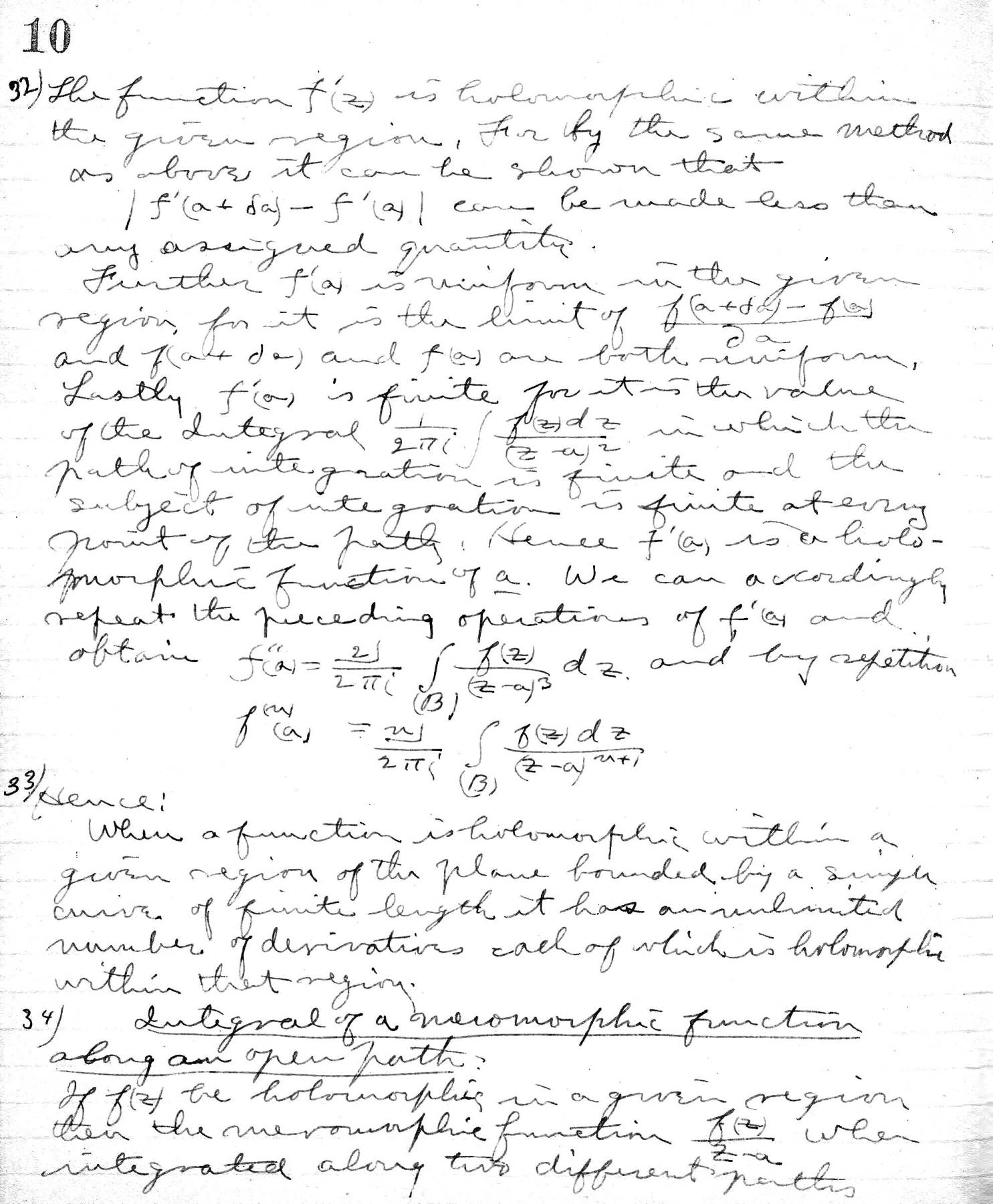
32) The function f(z) is holomorphic within
the given region. For by the same method
as above it can be shown that
f'(a)| can be made less than any assigned quantity.
Further f'(a) is uniform in the given
and f'(a+ and are both uniform,
Lastly, f(x) is finite for it is the value
of the Integral in which the path of integration is finite and the
subject of integration is finite at every
point of the path. Hence f'(a) is a holo-
morphic function of a. We can accordingly
repeat the preceding operations of f'(a) and
obtain f''(a) dz. and by repetition
33/ Hence:
When a function is holomorphic within a
given region of the plane bounded by a simple
curve of finite length it has an unlimited
number of derivatives each of which is holomorphic within that region.
34) Integral of a meromorphic function along an open path.
If f(z) be holomorphic in a given region
then the meromorphic function when integrated along two different paths
That is the run as the models left it. Yours comes with the record of every decision, to confirm or correct.
Transcribe 5 pages free