Skip to content

For lecturers

Turn your handwritten lecture notes into clean digital documents.

Drop in a scanned lecture. Lecturers.ai reads every section with independent AI models from two vendors, typesets the mathematics as real equations, and marks every line it isn’t sure of. When it can’t read a mark, it says so instead of guessing.

Nothing is sent to an AI model until you’ve seen the price and pressed Start.

See a real result Eight pages of 1904 lecture notes in the reader, no sign-up needed.

MSS
001791 B
SCDIRB Theory of Functions.
I
References to Forsyth
by articles, thus : [ ]³
Cornell University, Summer 1904.
John Irwin Hutchinson
1) Interpretation (geometrical) of the complex
variable. z=x+iy=rεiθz=x+iy=r\varepsilon^{i\theta}
Addition, subtraction, multiplication, intro-
preted geometrically by expressing in terms
of the coordinates (x,y)(x,y), or (r,θ)(r,θ)) [1-3]
Let w=f(z)w = f(z) and suppose that if z=x+iyz = x+iy
ww can be represented in the form w=u+ivw = u + iv.
then δwδx=dwdz;δwδy=idwdz\frac{\delta w}{\delta x} = \frac{dw}{dz} ; \frac{\delta w}{\delta y} = i \frac{dw}{dz} whence
2) 1) δuδx=δvδy;δuδy=−δvδx\frac{\delta u}{\delta x} = \frac{\delta v}{\delta y} ; \frac{\delta u}{\delta y} = - \frac{\delta v}{\delta x}
3) [ This is the condition that any expression of the form]
u+ivu+iv can be expressed as of(z).
These are also the conditions that dwdw shall
be unique [that is that there shall be one
slope or tangent in the w-plane regardless
of the method of approach to a point on the slope
dydx\frac{dy}{dx} in the zz plane]. For
dwdz=du+idvdx+idy=δuδx+δuδyy′+i(δvδx+δvδyy′)1+iy′{y′=dydx\frac{dw}{dz} = \frac{du+idv}{dx+idy} = \frac{\frac{\delta u}{\delta x} + \frac{\delta u}{\delta y} y' + i(\frac{\delta v}{\delta x} + \frac{\delta v}{\delta y} y')}{1+iy'} \{y' = \frac{dy}{dx}
To be independent of y, it is necessary for
the numerator to be divisible by 1+iy1 + iy
whence δuδx+iδvδx=(1iδuδy+δvδy)\frac{\delta u}{\delta x} + i \frac{\delta v}{\delta x} = \left(\frac{1}{i} \frac{\delta u}{\delta y} + \frac{\delta v}{\delta y}\right) [Equating real
[and imag^y parts]
and hence the above conditions.
(Picard II.n.2.)
A handwritten page headed Theory of Functions, Cornell University, Summer 1904, John Irwin Hutchinson: the complex variable z = x + iy, w = f(z) = u + iv, and the Cauchy–Riemann conditions written with deltas, with the working that shows dw/dz is independent of the direction of approach.
Drag to compareA real page from J. I. Hutchinson’s 1904 Cornell lectures on the theory of functions, and what our run made of it, line by line. The rule beside each line shows how closely the independent readings of that line agreed: of the page’s 24 sections, 4 look good, 1 is worth a quick check and 19 need review. Looks good Quick check Needs reviewExample page: Smithsonian Libraries and Archives, CC0.

One real run on lecture notes from 19048 pages156 sections468 model callsevery one on the record

§ 1 · How it works

From a scan to something you can teach from.

Three steps, and you can close the tab during the second. The document will be waiting.

  1. Drop a PDF

    Upload your scanned notes. A free preflight samples three pages, with no AI call, and prices every quality level against your own pages.

  2. Read by independent AIs

    Each section is read two or three times, separately, by models from Anthropic and OpenAI, each under different conditions. Plain code, not another AI, compares the readings.

  3. Review what’s flagged, then export

    Sections the readings agree on are marked as looking good. The rest come with a crop of your page and the candidate readings, so you confirm, correct or type it in.

§ 2 · The rule

It tells you what it doesn’t know.

Most tools hand back a clean page and leave you to find the mistakes. Lecturers.ai works the other way round: every decision it makes on its own is written down, and anything it couldn’t read is left as a marked gap. A stated gap beats a plausible fabrication.

Real run Summary for the eight sample pages, read on Standard

We made 130 decisions for you, and left 4 unread rather than guess.

That’s the sentence on every document’s summary, word for word. The run read these dense pages line by line, 156 sections for 8 pages, so a band belongs to one line: a δ\delta read as ∂\partial flags the line it’s on, not the page. Most of the lines that need review are one reading against two: the two Claude readings agree, and GPT-5.6 Terra reads the line differently. “Need review” is where to look, not a list of errors.

See a real result Open this run in the reader, page by page.

156 sectionsagreement, not accuracy
Look good25
Worth a quick check14
Need review113
Left unread4

Why a flag matters

Handwritten: point of the path. Hence f prime of a is a holo-

A line from Hutchinson’s page 10. Two readings read “point of the path. Hence f′(a)f'(a) is a holo-”. The third, which is also shown the whole page, wrote:

Moment of the particle; Kummer f′(a) as a limit

Fluent, plausible, and not on the page: Kummer is a mathematician, not a word Hutchinson wrote. The run kept the two that agree and banded the line needs review rather than pass it off as settled. One reading against two is exactly what the band is for.

A gap beats a fabrication

A faint pencil line: meromorphic, underlined; exs. F of z, F and P polynomial, log z.

A faint pencil line from Hutchinson’s page 5 (contrast raised here so you can see it): “meromorphic. exs. F(z)…”. Two readings made out most of it and said plainly that one word was illegible. The third, shown the whole page, began with a word that appears nowhere on it:

Transversality, 2xs. [illegible]

The run adopted none of them. Every reading, the sure-sounding one included, left part of the line illegible, so there was no whole reading to keep and nothing was filled in to make one. The line is one of 4 left unread, listed with its crop for you to type in:

unread We could not read this

§ 3 · The reader

Scan on the left, typeset on the right, line for line.

Every block sits where it was read on the page, so the two sides stay in step at any zoom. Mathematics is set as real equations, not pictures of them, and anything left unread is marked where it sits rather than quietly dropped.

  • Close either side for scan-only or text-only
  • Copy a page in one click; select-all copies your notes, never the interface
  • Every decision listed with its crop: confirm, correct, pick a reading, or type it
Scan
The top of a handwritten page: the difference quotient of f at a equals f prime of a plus sigma, where sigma tends to zero, followed by the Cauchy integral estimates for f prime of a.
Transcription
9
or f(a+δa)−f(a)δa=f′(a)+σ\frac{f(a+\delta a)-f(a)}{\delta a} = f'(a) + \sigma where lim⁡δa=0σ=0\lim_{\delta a = 0} \sigma = 0
Hence f′(a)−12πi∫f(z)dz(z−a)2=−σ+δa2πi∫f(z)dz(z−a)2(z−a−δa)f'(a) - \frac{1}{2\pi i} \int \frac{f(z) dz}{(z-a)^2} = -\sigma + \frac{\delta a}{2\pi i} \int \frac{f(z) dz}{(z-a)^2(z-a-\delta a)}
δa being a constant so far as the integration
relative to Z as concerned.
Then ∣f′(a)−12πi∫f(z)dz(z−a)2∣=∣−σ+δa2πi∫f(z)dz(z−a)2(z−a−δa)∣|f'(a) - \frac{1}{2\pi i}\int\frac{f(z)dz}{(z-a)^2}| = |-\sigma + \frac{\delta a}{2\pi i}\int\frac{f(z)dz}{(z-a)^2(z-a-\delta a)}|
<∣σ∣+∣δa∣2π∣∫f(z)dz(z−a)2(z−a−δa∣< |σ| + \frac{|\delta a|}{2\pi} |\int \frac{f(z) dz}{(z-a)^2(z-a-\delta a}|
Needs reviewp. 7

Read this as f′(a)−…f'(a) - \ldots, not f′(a)=…f'(a) = \ldots

The readings differed on a symbol that changes the meaning. Two read a minus sign after f′(a)f'(a), one read an equals sign. We took the majority reading and flagged it for you.

The handwritten line: Hence f prime of a minus one over two pi i times the integral of f of z dz over z minus a squared, equals minus sigma plus delta a over two pi i times the integral of f of z dz over z minus a squared times z minus a minus delta a.
  • f′(a)−12πi∫⋯=−σ+⋯f'(a) - \tfrac{1}{2\pi i}\textstyle\int \cdots = -\sigma + \cdots2 readings
  • f′(a)=12πi∫⋯=−σ+⋯f'(a) = \tfrac{1}{2\pi i}\textstyle\int \cdots = -\sigma + \cdots1 reading

The top of Hutchinson’s page 9 (page 7 of the sample), read line by line, with the readings and bands the real run gave it. In the highlighted line, two readings read f′(a)−12πi∫…f'(a) - \tfrac{1}{2\pi i}\int\ldots and one read f′(a)=12πi∫…f'(a) = \tfrac{1}{2\pi i}\int\ldots, a different equation. The run kept the majority, banded the line needs review, and put it to you in the record: that is the entry shown here.

The line above it carries the same band: all three set the equation alike, but one took Hutchinson’s “or” for ∼\sim. The page number looks good.

§ 4 · Figures

Rough sketches, redrawn for print.

We redraw the figure, show you exactly what we changed, and never invent what we could not read.

  • Snap one figure, or pull every figure out of a lecture
  • Check the crops, and erase stray text before anything is redrawn
  • Attach figures from your own notes, and new ones match their style
  • Image engine, or vector with real, editable labels · SVG, PNG or PDF
Before The manuscript
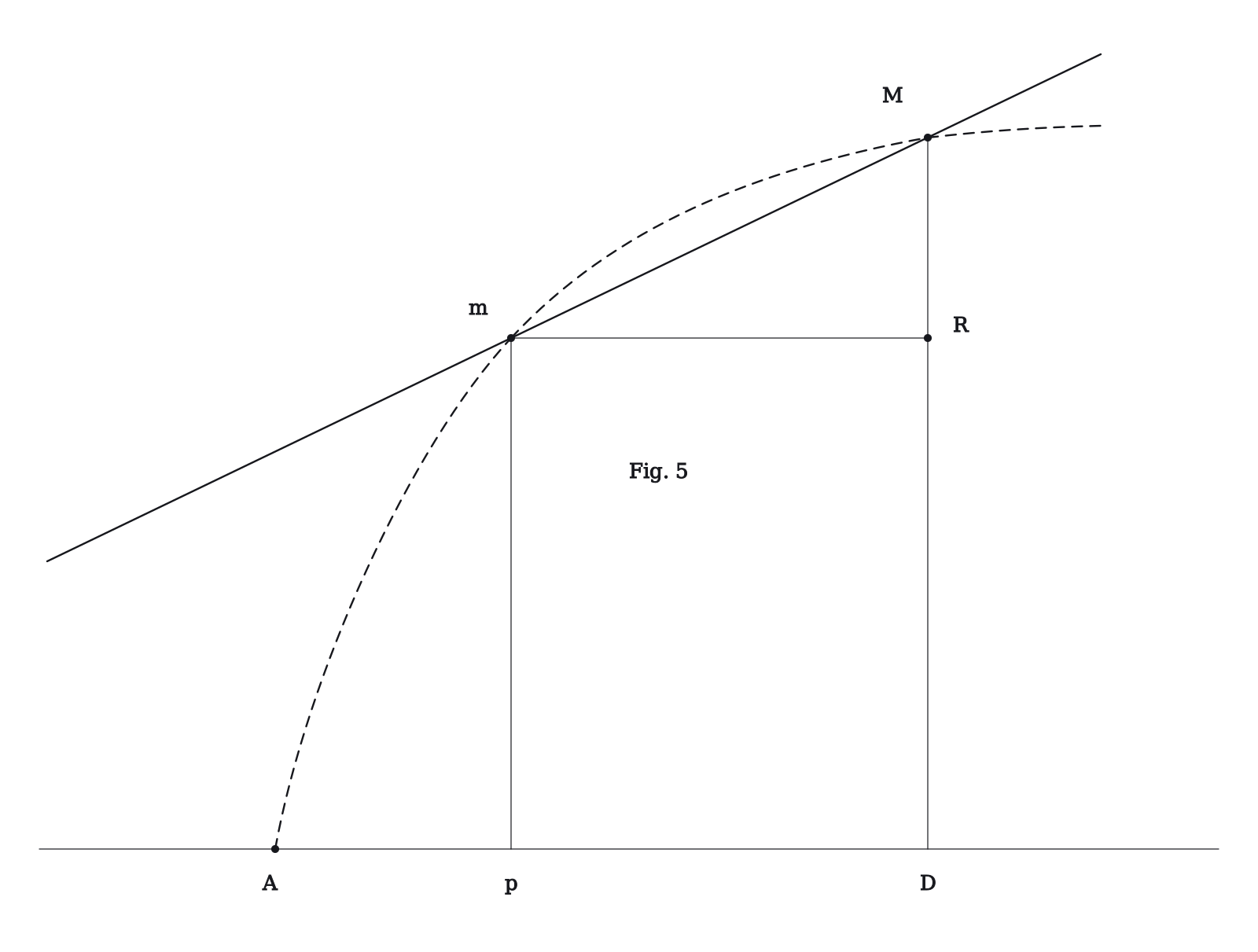
An 18th-century pen drawing, Fig. 5: a dotted curve rising from A through points m and M, a straight line through m and M, vertical ordinates from m and M down to p and P on a base line, and a horizontal from m to k.
After Textbook style, vectorOpen the SVG
The redraw: the same curve as an even dashed line through m and M, the straight line through them, the ordinates to p and D, and the horizontal from m to R, with typeset labels A, p, D, m, M, R and Fig. 5.

What changed

“Only drawing quality was altered (straight strokes, even dashes, two stroke weights, typeset labels, removal of paper grain and an ink blot on the ordinate mp).”

Labels

“The label at the right end of the horizontal mR is written with a flourish and read here as ‘R’.” Every label is real, editable text in the SVG.

What we couldn’t read

“A faint mark on the base line between p and D, at the very bottom edge of the scan, could not be read and has been omitted.”

ManuscriptRedrawThe tool’s notesFlagged: “read here as ‘R’”Not flagged

Check it against the source. The tool flagged its R, which Saunderson wrote as k. It didn’t flag its D: that is his P. That is why every redraw comes back beside its source, with its notes.

The sketch is Fig. 5 from Nicholas Saunderson’s 18th-century manuscript on fluxions: a curve, the straight line through its points m and M, and the ordinates mp and MP. The redraw is the Figures tool’s real output for it (Clean up, Textbook style, vector engine), and the notes are the tool’s own, word for word. Source: Smithsonian Libraries and Archives, CC0.

§ 5 · Price before you pay

See the price before you pay it.

Choose how carefully we read. Each quality level is priced against your own pages before anything is sent to a model, and a hard cap means there’s never a surprise bill.

Example lecture25 pages · estimates, priced before anything runs

Draft
2 readings · 2 AI vendors

Two independent readings, at reduced resolution.

≈$7.70≈ 380 credits

Enough to catch a disagreement, not always enough to settle one, so more lands in your review list.

StandardRecommended
3 readings · 2 AI vendors

Three readings across two vendors, at full resolution.

≈$9.70≈ 490 credits

The right choice for most notes. Where the readings still disagree, the section is flagged for you rather than guessed.

Careful
3 readings + a 4th on anything unclear

Our strongest models, and a fourth reading where the first three disagree.

≈$40≈ 2,020 credits

Costs several times more, because most sections earn the fourth reading. Worth it where the notation carries the meaning.

A cap, not an estimate

Set a ceiling and the run stops there, at the next section boundary, never halfway through one. Anything it didn’t reach is listed and marked as unread, so the result never looks finished when it isn’t.

Example quotes for a 25-page lecture at Pro-plan rates. Quotes are estimates: on completed runs they’ve landed within about ±30% of the actual cost. The cap is exact.

Take it with you

  • PDF.pdf
  • Word.docx
  • LaTeX.tex
  • Markdown.md
  • Plain text.txt

Unread passages are visibly marked in every format. Each export’s header records the source file, the date and the models used.

§ 6 · Provenance

Know exactly what produced your document.

Every reading has a name on it

Each reading records the model that produced it, and each document records its calls, tokens and cost. A disagreement can always be traced to its source.

Your science is never “corrected”

If something looks off, we tell you. We never quietly fix it: a flag means “look here”, not “we changed this”.

Your original is never overwritten

Corrections go into an append-only log. Your source file and the original readings stay exactly as they were.

We check the scanner, too

Some scanners swap one similar-looking mark for another to save space. We count pixel-identical marks on every page and tell you if letterforms could be affected.

Pricing

Pay for pages, not tokens.

Your first 5 pages are free. After that, a monthly allowance of pages, with packs for heavy weeks. Every run is quoted before it starts.

See plans and what a page buys

Free trial

Try it on 5 of your own pages.

Free

About 5 pages at Standard

Pro

Recommended

For a course’s worth of notes.

$29/ month

or $290 a year

About 75 pages a month at Standard

Extra credits

A heavy week, without changing plan.

$10one-off

About 25 more pages at Standard

Questions

What lecturers ask first.

Something else? Write to us at support@lecturers.ai.

What happens when my handwriting is illegible?

We leave it unread and say so. When the readings can’t make out a mark, or disagree too far to choose between, that passage is marked as unread in the reader and in every export, and listed in the record with the crop of your page beside it, ready for you to type in.

We never fill a gap with a plausible guess. In the run behind our sample, one of three readers opened a faint pencil line with “Transversality”, a word the author never wrote. All three readings left part of the line illegible, so the run left it unread rather than adopt any of them.

Which AI models read my notes?

Models from Anthropic (Claude) and OpenAI (GPT), so that agreement is never one model agreeing with itself. Which ones depends on the quality level you choose, and we pick them by measuring them on real lecture pages rather than by reputation.

Every reading in your document records the exact model that produced it, and every export lists the models used. Figures uses GPT Image 2 for its image engine.

Are my notes used to train AI models?

We don’t train models on your notes. To read your pages we send them to Anthropic and OpenAI through their APIs, and what those providers may do with API data, including training and retention, is governed by their terms. Our AI policy sets out the current details. We’d rather point you to the terms than make a promise we can’t enforce.

What files can I upload?

For transcription, a PDF of your scanned notes, from a scanner or a phone scanning app. For Figures, a PDF or an image (a photo, screenshot or whiteboard snap), or paste one straight in.

Before anything is read we check the scan itself: some scanners quietly swap similar-looking marks to save space, and we count for exactly that.

How much does it cost, and can I cap it?

Your first 5 pages are free. After that you pay for pages; see pricing.

Before a run starts, a free preflight samples three of your pages (no AI call, no cost) and quotes every quality level against them. Our estimates have landed within about ±30% of the actual cost on completed runs. The spending cap is not an estimate: the run stops there, never mid-section, and lists whatever it didn’t reach.

A rewritten version (Match Intent, the default, or Cleaned Up, Explained, Try Something New or Custom) adds about 2 to 8 credits a page, shown as its own line in your quote before anything runs. It is written from your transcription, so the page is never read twice.

Can I edit the transcription?

Yes, where it matters. “What we decided” lists every decision with the crop of your page beside it. For each one you can confirm it, correct it, pick between the candidate readings, type it yourself, or mark it as can’t tell.

Corrections go into an append-only log, so the original reading is never overwritten. For free-form editing, export to Word, LaTeX or Markdown.

What can I export?

PDF, Word (.docx), slides for PowerPoint and Keynote (.pptx, with the equations typeset), LaTeX, Markdown and plain text. Unread passages are visibly marked in every format rather than dropped, and each export’s header records the source file, the date, the target and the models used.

Does “looks good” mean it’s correct?

No, and we won’t pretend it does. The marks show how closely independent readings agreed, which is not the same as accuracy. Agreement is computed by plain code rather than by another AI, so the same readings always earn the same marks. Check anything that matters before you teach from it; the marks tell you where to start.

Bring one lecture. We’ll show you what we couldn’t read.

See the price first, read it beside the page it came from, and export it when you’re happy.

Transcribe 5 pages free